SERP Domination Playbook: The Results Are In — And They’re Brutal
This is a follow-up to SERP Domination Playbook: Owning Page 1 For a Single SKU, published on February 14, 2026. If you haven’t read the original, start there. It lays out the full strategy. This post shows what happened when we executed it.
From Theory to Proof: Two SERPs, One Verdict
A month ago, I published the playbook for owning Google’s first page with a single product. The strategy was clear: build multiple content types across multiple owned properties, each targeting a different SERP slot, all converging on one SKU.
Some people thought it was ambitious. Some thought it was unrealistic.
Here are the actual results.
SERP #1: The Product Query
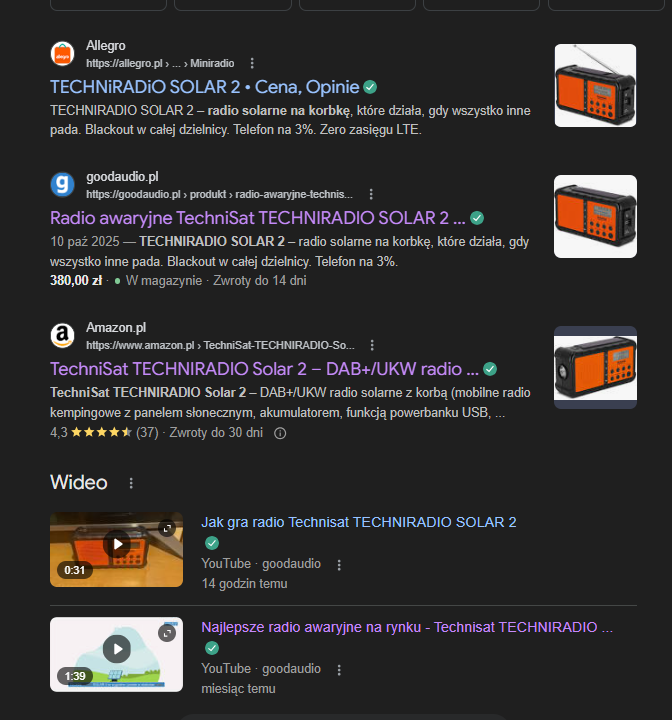
For the primary transactional query — the one a buyer types when they already know the product and are ready to purchase — here is what page one looks like right now:
Position 1 — My Allegro listing (marketplace auction) Position 2 — My store (goodaudio.pl — product page) Position 4 — My YouTube video (product demo) Position 5 — My YouTube video (editorial review)
Four out of the first five organic positions are mine. The only result I don’t own is Amazon at position 3. Every other visible slot on the page belongs to my ecosystem.
Let that sink in. A potential buyer searches for this product by name. They see my auction first. Then my store. Then Amazon. Then two of my videos. Before they scroll, I have controlled four out of five touchpoints in their decision journey.
The competitor’s path to visibility? They would need to outrank an established marketplace listing, a topically dense product store, and two indexed YouTube videos — all controlled by the same entity, all reinforcing the same narrative, all pointing at the same SKU. Good luck.
SERP #2: The Research Query
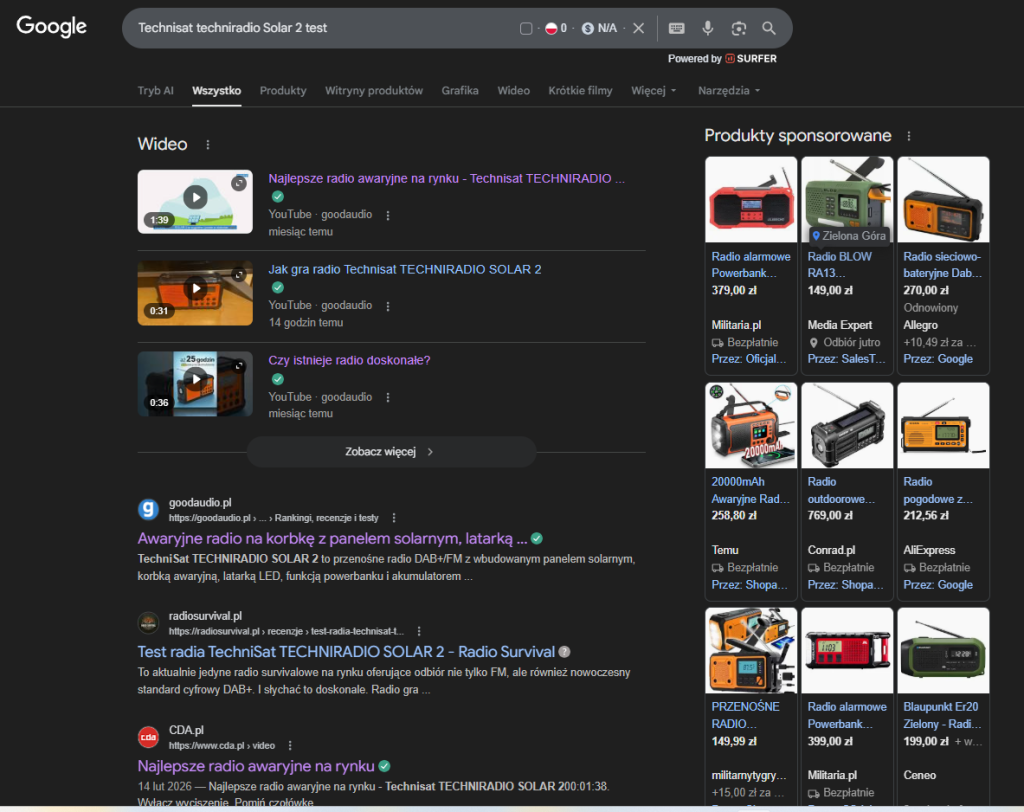
For the research-stage query — “Technisat Techniradio Solar 2 test” — the results are even more one-sided:
Position 1 — My YouTube video (full product review) Position 2 — My YouTube video (product demo, “how it sounds”) Position 3 — My YouTube video (editorial deep-dive) Position 4 — My store (goodaudio.pl — ranking page) Position 5 — My store (radiosurvival.pl — product review) Position 6 — My CDA channel (video mirror on Poland’s native video platform)
Six out of six. Every single visible organic result on page one belongs to me. Not four out of five. Not five out of six. All six.
A user searching for a test of this product will see my content in every position. My video reviews. My written review. My ranking page. My second store domain. My presence on an alternative video platform. There is literally nowhere else to look.
This is not market share. This is market ownership.
The Anatomy of Total SERP Control
Let me break down what is actually happening here, because the surface-level read — “he ranks a lot” — misses the strategic depth.
Multiple Content Types, Multiple Intents
Across these two SERPs, I am occupying positions with five distinct content formats:
- Marketplace listing (Allegro) — catches users who prefer buying through trusted platforms
- Product store page (goodaudio.pl) — captures direct transactional intent
- Review/ranking page (radiosurvival.pl) — serves the “should I buy this?” intent
- YouTube videos (3 separate videos) — dominates video carousel and blended results
- Alternative video platform (CDA.pl) — captures platform-specific search behavior
Each format serves a different moment in the buyer’s journey. Each ranks independently because Google sees them as genuinely different content types providing different value. This is not duplicate content wearing different hats. These are distinct assets serving distinct purposes.
Multiple Domains, Compounding Authority
The results span four separate web properties:
- goodaudio.pl — the primary store and content hub
- radiosurvival.pl — a dedicated single-product store with its own review content
- YouTube (goodaudio channel) — video content ranking in both blended and video results
- CDA.pl (goodaudio channel) — video presence on Poland’s domestic video platform
Each domain contributes its own authority signal. Google’s diversity filter, which normally prevents a single domain from hogging the SERP, works in my favor here — because these are genuinely separate properties with distinct content.
The Video Layer Nobody Talks About
Notice something: video content occupies three positions in the research SERP and two in the transactional SERP. Most e-commerce SEOs ignore video entirely. They are leaving positions on the table.
Google increasingly blends video results into product queries. A 30-second product demo, a sound quality test, an unboxing — these are not expensive to produce, but they claim SERP real estate that no amount of written content can touch.
In the research SERP, my three YouTube videos form a video carousel that pushes all written results below the fold on mobile. A competitor could write the best review article in history, and it would still appear below my video wall.
This is why a multi-format content strategy is not optional. Text ranks in text slots. Video ranks in video slots. If you only produce one format, you are conceding half the battlefield.
The Playbook Validated: What the Data Proves
In the original article, I outlined seven content types that can rank independently for product queries. Let me map the theory to the actual results:
| Playbook Content Type | Live Asset | SERP Position |
|---|---|---|
| Product page (transactional) | goodaudio.pl product page | #2 (product SERP) |
| Marketplace listing | Allegro auction | #1 (product SERP) |
| Ranking/review page | goodaudio.pl ranking | #4 (research SERP) |
| External domain review | radiosurvival.pl review | #5 (research SERP) |
| Video content (YouTube) | 3 separate videos | #1, #2, #3 (research SERP); #4, #5 (product SERP) |
| Alternative platform | CDA.pl video | #6 (research SERP) |
Six of the seven playbook slots are actively occupied. The only missing piece is a dedicated long-form buying guide — and that is already in production.
The original playbook predicted that a single SKU could occupy three to five positions on page one. The actual result: four out of five on the transactional SERP, and six out of six on the research SERP. The prediction was conservative.
What This Means in Business Terms
Forget rankings for a moment. Think about what this means for revenue.
Every position on page one that I control is a position a competitor does not have. In a normal competitive SERP, my store might capture 15-20% of clicks. With four to six positions? The click-through rate across my properties approaches 70-80% of all organic clicks for these queries.
A buyer literally cannot research this product without encountering my content. They can click position one, two, three, four, five, or six — and they end up in my ecosystem every time. The purchase becomes almost inevitable.
And every single click is free. No ad spend. No CPC bidding war. No margin erosion.
The content creation cost was real but finite. The returns compound indefinitely.
The Competitive Moat
Here is the part competitors hate: this is not easy to replicate quickly.
To displace me from even one position, a competitor would need to:
- Build a product page with more depth and better schema than mine
- Create video content and wait for it to gain YouTube authority
- Establish a second domain with topical relevance and independent trust signals
- Write ranking content that outperforms pages backed by months of crawl history
- Build marketplace presence with competitive pricing and reviews
And they would need to do all of that simultaneously, because taking one position does not help if I still hold the other five. The cost of attacking a fortified SERP is orders of magnitude higher than the cost of building it.
This is the moat. Not a technical trick. Not a backlink profile. Not a domain age advantage. The moat is the sheer density of high-quality, multi-format, multi-domain content that would take any competitor months to match — by which time I will have added even more.
What Comes Next
The playbook is not finished. Here is what is in progress:
- Long-form buying guide targeting “how to choose a survival radio” and related informational queries — filling the last empty slot in the seven-type framework
- Additional video content targeting unboxing, comparison, and “X days with this radio” formats — expanding the video carousel dominance
- International expansion — the same playbook adapted for English-language markets through how2own-seo.com and related properties
- New product launches — applying the proven framework to additional SKUs in the radiosurvival.pl store
Every new asset added makes the existing positions stronger through internal linking and topical reinforcement. The flywheel is turning.
The Bottom Line
One product. Two SERPs. Ten positions controlled out of eleven possible.
This is what Pure SEO Density looks like in practice. Not theory. Not a case study from 2019. Live, verifiable results from an active campaign, documented as it happens.
The playbook works. The only question is whether you have the discipline to execute it.
This is an ongoing live case study by Pruciak Capital. The product is the TechniSat TECHNIRADIO SOLAR 2, sold through goodaudio.pl and radiosurvival.pl. All SERP data is from March 2026 and independently verifiable. Next update: Q2 2026 with revenue attribution data.