
SERP Domination Playbook: Owning Page 1 For a Single SKU
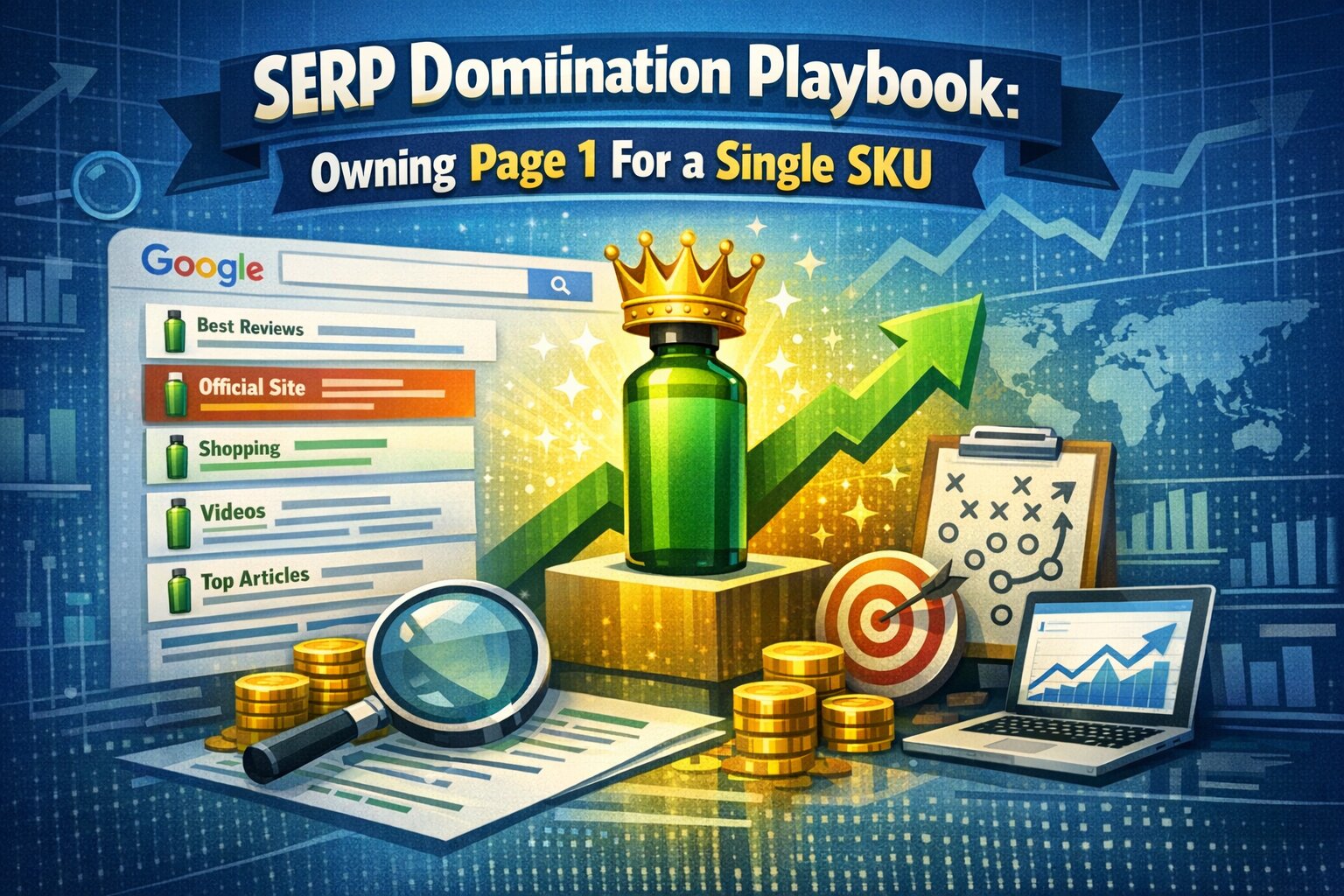
Most SEO strategies spread thin. Hundreds of products, thousands of keywords, endless content calendars. The logic seems sound — more pages, more chances to rank. But there is a brutal counterargument hiding in plain sight: what if concentrating all your firepower on a single product gives you more SERP real estate than an entire catalog ever could?
This is not theory. We are running this playbook right now. And the mechanics behind it apply to any niche, any product, any market.
The Core Idea: Multiple Positions, One Product
Google’s first page has ten organic spots. For any product-related query, those spots are typically divided among different content types — product pages, reviews, comparisons, rankings, informational articles, forum threads. Google wants diversity. It wants to serve different intents within the same query.
Most stores occupy one of those spots at best. Their product page. Maybe a category page. That is it.
The playbook is simple in concept, ruthless in execution: create content assets that qualify for as many of those SERP slots as possible, across multiple domains you control. Not duplicate content. Not thin variations. Genuinely different content types, each serving a different search intent, each capable of ranking independently — all pointing to the same product.
When done right, a single SKU can occupy three, four, even five positions on page one. Your competitor sees one listing. You see a wall.
The Seven Content Types That Rank Independently
Every product-related SERP is a battlefield with distinct slots. Here is every content type that can claim one, and how to build each.
1. The Product Page (Transactional Slot)
This is your home base. The page where the transaction happens. Most stores treat product pages as spec sheets with an “Add to Cart” button. That is a mistake.
A product page that ranks needs depth. Detailed descriptions written for the buyer, not copied from the manufacturer. Real-world usage context. Technical specs presented in a way that answers questions before they are asked. Schema markup — Product, Offer, AggregateRating at minimum.
The product page targets the most transactional queries: brand + model name, “buy “, exact SKU searches.
2. The “Best Of” Ranking Article (Commercial Investigation Slot)
This is arguably the most powerful asset in the playbook. “Best survival radio”, “best portable radio with battery”, “best emergency radio 2025” — these queries have massive volume and sit right at the edge of purchase intent.
The key: your product does not just appear in the ranking. It wins the ranking. Position one in the article. The logic is self-reinforcing — you control the editorial, you control the verdict.
But here is where most people stop at one ranking. We build multiple rankings from different angles, each targeting a different keyword cluster. A single product can legitimately be number one in “best survival radio”, “best radio with solar charging”, “best portable radio with powerbank”, and “best DAB+ emergency radio” — because each list applies different criteria and the product happens to excel across all of them.
In our current live test, one product holds the top spot in seven separate ranking articles on the store domain alone.
3. The Head-to-Head Comparison (Decision-Stage Slot)
“[Product A] vs [Product B]” queries are goldmines. The user already knows what they want — they are choosing between two options. Conversion rates from comparison content are among the highest in e-commerce SEO.
Pick the most obvious competitor product. Build a thorough, honest comparison. Structure it so Google can pull featured snippets — spec tables, clear verdict sections, pros/cons.
The comparison page ranks for queries your product page never will. It captures users at a different stage of the funnel and funnels them toward your SKU.
4. The Informational/Problem-Solving Article (Awareness Slot)
Not everyone searching is ready to buy. Some are researching a problem. “What radio to use during a power outage.” “How to prepare a survival kit.” “What is DAB+ radio.”
These informational queries are top-of-funnel, but they do two critical things. First, they build topical authority for your domain in Google’s eyes. Second, they introduce your product as the solution within genuinely helpful content.
The move: find existing informational articles on your site that are already indexed and have some authority. Update them to naturally include your product as a recommended option. You get a ranking boost from the article’s existing history, and the product gains an additional entry point.
5. The External Ranking (Third-Party Authority Slot)
This is where the strategy gets aggressive. If you operate a second domain — a review site, a ranking portal, a niche magazine — you can create independent ranking content on that property that links back to your product on the store.
Google treats this as a separate editorial voice. It is not the store recommending its own product — it is an external, topically relevant authority confirming the recommendation. In SERP terms, you now have two different domains competing for the same keyword, and you control both.
In our setup, we use a dedicated ranking portal where the product appears in the top three across five separate rankings. Each ranking links back to the store. The external domain provides referral traffic, relevance signals, and — most importantly — occupies an additional organic position that would otherwise go to a competitor.
6. The Category/Collection Page (Browse-Intent Slot)
Category pages rank for broader queries — “emergency radios”, “survival gear”, “portable radios.” Even if your store only carries a handful of products, a well-structured category page with strong copy, filters, and internal links can compete for these terms.
When the category page ranks and the product page ranks for more specific queries, you start stacking positions. The user sees your brand twice before they even click.
7. The Long-Form Guide (Educational Slot)
Buying guides, how-to articles, “everything you need to know about [topic]” — these long-form pieces target informational keywords with high volume. They rank for dozens of long-tail variations and drive consistent top-of-funnel traffic.
The guide naturally references your product as the recommended choice within a broader educational context. It does not feel like a sales pitch — it feels like expertise.
The Cross-Domain Architecture
Running this playbook on a single domain is effective. Running it across multiple owned domains is where it becomes a competitive moat.
Here is the structural model:
Domain A — The Store. Hosts the product page, ranking articles, comparison articles, and informational content. This is where the transaction happens.
Domain B — The Authority Site. A separate, niche-focused property (ranking portal, review site, editorial magazine). Hosts independent rankings and reviews that link to Domain A. Provides third-party validation and occupies additional SERP positions.
Domain C, D, E — Additional Satellites. If you operate more specialized portals, each can contribute a ranking, a review, or a mention. Every additional domain is a potential additional position on page one.
The critical rule: each domain must provide standalone value. Thin affiliate pages or doorway sites will get filtered out. Every piece of content must be something a real user would find genuinely useful. Google’s diversity filter rewards legitimate multi-source coverage. It penalizes obvious manipulation.
This is the philosophy behind what we call Pure SEO Density — building real content assets across owned properties that reinforce each other naturally. No bought links, no PBNs, no spam. Just density of genuine value around a single topic.
Live Example: Executing the Playbook
We are currently running this exact playbook on a Technisat emergency radio with solar charging in the Polish market. Here is the current asset map:
- Product page on the store (transactional queries)
- Top pick in 7 ranking articles on the store (commercial investigation queries)
- 1 head-to-head comparison article (decision-stage queries)
- 1 updated informational article about crisis radios (awareness queries)
- Featured in TOP Product section on the store homepage (internal authority signal)
- Top 3 in 5 rankings on a separate ranking portal (external authority + additional SERP positions)
Total content assets pointing at one SKU: 15+ across two domains.
The target: position one in Google for the primary product query — outranking the manufacturer’s own listing. The goal is not just to rank. It is to own the SERP so comprehensively that a competitor would need to replicate the entire content infrastructure to displace us. That takes months. By then, we are further ahead.
How to Replicate This
If you want to run this playbook, here is the minimum viable version.
Step 1: Pick the right product. Choose something with genuine search demand, moderate competition, and enough angles to justify multiple content pieces. If you cannot write seven different ranking articles that each feel natural, the product is wrong.
Step 2: Map the SERP. Search your primary keywords right now. Look at what content types occupy page one. Product pages? Rankings? Comparisons? Guides? Forums? Every content type you see is a slot you can target.
Step 3: Build the asset stack on your store domain. Product page, at least three ranking articles from different angles, one comparison, one informational article. Each targets a distinct keyword cluster. Each links internally to the product page.
Step 4: Build external assets. If you have a second domain (or can build one), create independent rankings that reference the product. The domain needs to be legitimate and topically relevant — not a throwaway site.
Step 5: Consolidate internal signals. Feature the product prominently on your homepage. Ensure internal linking from every relevant page points to the product page. Breadcrumbs, related products, sidebar features — every signal counts when you are focusing all authority on one URL.
Step 6: Monitor and iterate. Track which content types are gaining traction, which queries you are appearing for, and where competitors still hold positions. Fill the gaps. Update content as you gather data.
The Math That Makes This Dangerous
Consider the economics. A typical one product store running paid ads might spend $5–15 per click. At a 2-3% conversion rate, customer acquisition cost lands somewhere between $150 and $750 depending on the niche.
An SEO-driven one product store has a fixed content creation cost and zero marginal cost per visitor. Once the content ranks, every click is free. The ROI curve does not flatten — it steepens over time as content authority compounds.
The tradeoff is patience. Paid ads deliver traffic today. This playbook takes weeks to months to reach full velocity. But once it does, no one can turn it off by outbidding you.
The Uncomfortable Truth
Most SEOs will not do this. It requires concentrated effort on a single product when every instinct says to diversify. It requires owning multiple legitimate web properties. It requires writing content that is actually good — not filler optimized for a keyword density score.
But that is exactly why it works. The barrier to execution is the moat.
Ten mediocre product pages will always lose to one product backed by fifteen pieces of purpose-built, strategically interlocked content. Every time.
This playbook is part of an ongoing live experiment by Pruciak Capital using the Pure SEO Density methodology. Results and data will be published as the case study progresses.


